網頁

2011年4月21日 星期四

Eyes on Africa Presentation Self-Reflection

In this presentation, I have talked about Congo. I didn't want to do it in a boring way so I choose to make a story book, even though I know I am a very bad artist. I spend the whole spring break to finish my presentation and I have tried to put as many pictures as I can because it can shows how pitiful Congo people are. First, I introduce Congo, so others can know where is Congo and it's basic information.


PICTURE


 Secondly, I talked about Rubber. Rubber was the most important resource and most people rely on it during the time before colonial period. Rubber also shows how cruel the government do to Congo workers and how hopeless the workers were.


PICTURE

Since my idea was to show how cruel Congo people were so I choose a book, written during colonial time and also talked about the darkness side of Congo, Heat of Darkness. It was written by a British who went to Congo and saw the darkness of it. He went back to England because he have some health problem and he wrote this book a few years after he came back from Congo. I really like the main idea of this book and I would like to read it someday.


PICTURE


The last topic I wrote about Congo is the second war of Congo. It is a war between 8 country, Namibia, Zimbabwe, Angola, Chad, Mai,-Mai, Hutu, Uganda, Rwanda and Burundi. There are a lot of refugee during the war and I think it is also the dark side of Congo because Congo have so many wars and those refugee can't get good medical care and other daily needs.


PICTURE


My presentation was success this time but there are still many small problems. Such as, stick the wrong details to different topic, or even doesn't know how to pronounce some special name. I will try my best to improve my art work and everything.

2011年4月15日 星期五

Hutu and Tutsi


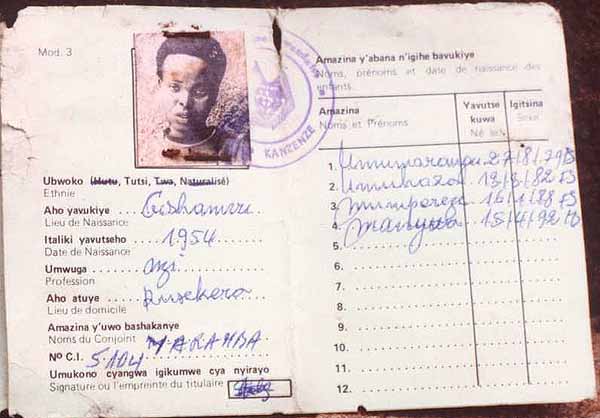
Starting in 1935, the Belgian Colonial government required all citizens to have "Tutsi", "Hutu" or "Twa" indicated on their identity cards. Admission to school was limited to only Tutsi. Following World War II, Rwanda began the process of becoming an independent country. First, it was made into UN trust territory with Belgium appointed as administrative authority. Belgium continued to support the Tutsi minority rule.
In 1954 King Mutara III began to redistribute and share out the land between the Hutu and the Tutsi. He also agreed to abolish the ubuhake and uburetwa system of indentured servitude which had been in place since the 15th Century. Ubuhake was a system of cattle distribution and uburetwa was a land distribution system. Historically, Hutus were farmers while Tutsis were primarily cattle-raisers.
In 1961, the Belgian-sponsored Tutsi monarchy collapsed and Kigeli V was exiled from Rwanda. That same year, political power was transferred from the minority Tutsi to the majority Hutu. Kigeli V, also known by his Christian name of Jean-Baptiste, currently lives in the United States and has expressed a desire to return to Rwanda as its constitutional monarch to re-unite and heal the country. In neighboring Burundi, the minority Tutsis, maintained control of the government.
In Burundi in 1972, the Tutsi government launched a campaign of genocide against Hutu population and an estimated 100,000 Hutus died. In 1993, Melchior Ndadaye a Hutu and Burundi's first democratically elected president was assassinated by Tutsi officers. This sparked wide-spread violence between Hutu and the Tutsi, in which an estimated 500,000 Burundians have died. This violence spread to neighboring Rwanda and was one of the causes of the 1994 Rwandan genocide.


2011年4月14日 星期四

Reflection of Hotel Rwanda

This is one of the best movies I have ever seen. Every  second of the movie is captivating, you do not know what is going to happen next. I could not take my eyes off the screen. This movie was made to educate the world about the 1994 Rwandan genocide. Sometimes movies that tried to tell a true story are very boring but not this one.
 Don Cheadle played the main character Paul Rusesabagina who was a hotel manager  that saved thousands of people during the genocide. This actor did an excellent job portraying this character. He made every scene enjoyable to watch. He also spent time with the real life Paul Rusesabagina.
British actress Sophie Okonedo played Paul's wife Tatiana. They love each other deeply and the talented actors show this very clearly. Both Sophie Okonedo and Don Cheadle were nominated for Academy Awards. 
To capture the realism of the story, some of the movie was filmed in Kigali Rwanda where the real story took place. I think this really added to the power of the movie, knowing that the actors were in the same place as the real people. 


2011年3月15日 星期二

Dr. Livingstone, I presume?

“Dr. Livingstone, I presume?” This famous question was asked by Henry Morton Stanley on October 27, 1871 near Lake Tanganyika in present-day Tanzania. Even though, there were no other white men around, the two had not been formally introduced, so it was a proper way to address Dr. David Livingstone without committing a breach of etiquette.
Dr. David Livingstone (19 March 1813 – 1 May 1873) was a Scottish missionary and explorer. Unlike many of the people at the time, Livingstone was strongly anti-slavery.
Livingstone made many journeys in Africa and drew many detailed maps used by later explorers.One one of his journeys Livingstone caught pneumonia and had no contact with the outside world for almost ten years.
Henry Morton Stanley (28 January 1841-10 May 1904) was sent by the New York Herald to find Livingstone. When he located Livingstone, the famous question was asked. Stanley was a Welsh journalist and explorer.

Stanley wrote about his travels and adventures in the book, In Darkest Africa, one of his many books.

2011年3月8日 星期二

Liberia

Along with Ethiopia, Liberia was the only African nation to resist formal colonization by a European power during the Scramble for Africa.
In early 19th century, the American Colonization Society worked to allow free American slaves return to Africa.
Some emancipated slaves  choose to emigrate to an area in western Africa. The colony was originally named Monrovia in honor of President James Monroe These settlers declared the Republic of Liberia on July 26, 1847.
 They choose the name Liberia because it means "Land of the free" in Latin. They saw this as promised land where they could finally be free.
Liberia retained the name Monrovia for its capital city and it remains so today. Unfortunately, today Liberia is one of the world's poorest countries and has suffered through decades of civil war.

Humanities Essay (Revised)

Capitalism vs. Socialism

Although capitalism and socialism have their roots in earlier centuries, they became more developed and influential in the 19th century. Both capitalism and socialism are economic theories that are concerned with the means of production and the allocation of wealth and resources. This concern is the only similarity between these two very different economic theories. 
In capitalism, the means of production are privately owned and the wealth that is produce is kept by the factory owners and investors. There is little or no government intervention. How the factory owners choose to use their resources is left up to them not the government. Capitalism is a product of the industrial revolution and replaced mercantilism as the main economic system of Europe in the second half of the 19th century.
In socialism, the means of production are owned collectively by the workers. Wealth is distributed evenly among the workers and reinvested in the factory. The decision about how to use their resources is determined by all the workers through discussion and debate. Socialism has it roots in Christianity, but developed in the 19th century as a direct response to capitalism.
Two famous economists from the Austrian School, Ludwig von Mises and Friedrich Hayek had strong criticisms of socialism. They argued that workers making collective decisions about what to manufacture could not achieve the most productive or efficient allocation of capital and the means of production. In their opinion, a market economy is essential to determine supply and demand.
Capitalism in the 19th century was very different from capitalism today. Workers were commonly injured or killed due to terrible working conditions. They worked long hours for little pay. Even children could be found working in factories. Socialism criticized these inhumane working conditions and tried to find a better way to control the means of production and allocation of wealth and resources. Most modern economies have some elements of capitalisms and socialisms, pure capitalist or pure socialist economies do not exist.

2011年3月1日 星期二

Humanities Essay

Capitalism vs. Socialism

Both capitalism and socialism are economic theories that are concern with the means of production and the allocation of wealth and resources. Although capitalism and socialism have their roots in earlier centuries, they became more developed and influential in the 19th century.
In capitalism, the means of production are privately owned and the wealth that is produce is kept by the factory owners and investors. There is little or no government intervention. How the factory owners choose to use their resources is left up to them not the government. Capitalism is a product of the industrial revolution and replaced mercantilism as the main economic system of Europe in the second half of the 19th century.
In socialism, the means of production are owned collectively by the workers. Wealth is distributed evenly among the workers and reinvested in the factory. The decision about how to use their resources is determined by all the workers through discussion and debate. Socialism has it roots in Christianity, but developed in the 19th century as a direct response to capitalism.
Two famous economists from the Austrian School, Ludwig von Mises and Friedrich Hayek had strong criticisms of socialism. They argued that workers making collective decisions about what to manufacture could not achieve the most productive or efficient allocation of capital and the means of production. In their opinion, a market economy is essential to determine supply and demand.
Capitalism in the 19th century was very different from capitalism today. Workers were commonly injured or killed due to terrible working conditions. They worked long hours for little pay. Even children could be found working in factories. Socialism criticized these inhumane working conditions and tried to find a better way to control the means of production and allocation of wealth and resources.